Starting from Scratch

Hello! It's been almost 4 months since I've written in this space. I've taken a short hiatus to move to a new city, start a new job, and wholly restructure my life. Suffice to say it's been a stressful and incredible few moths full of change and overwhelming happiness. Before I jump into the meat of this post- sharing how I went about building a kitchen from scratch, on a budget- I want to share some very happy news. Last weekend, in a quiet and lovely moment in Central Park, Ian and I got engaged. 

Let's rewind to 2 month's ago when we packed up a UHaul with our dog Jack, fish Harry and set out for NYC. In DC, we were living in a fairly cramped space with a roommate, sharing our kitchen along with all the ins and outs of daily life. We had no need for a lot of basics- they were shared- so the move to Bed Stuy and an apartment of our own meant starting our kitchen from scratch. To prepare, I did due diligence by researching helpful tips for what kitchen basics entail. You know, the bare necessities of cooking: spices, pots, pans, utensils, etc. I'm not sure why, or when the trends changed, but per usual I was reminded why I started this blog. Every single source I referred to from Food52 to Martha Stewart to Rachel Ray (I went there.) provided lists and tips that were for the most part inaccessible for someone living on a budget, working full time, or not looking to compile a pantry of trendy kitchen ingredients. I love Food52 but a search for the founder's essentials brought me to this list which... well, let's just say that if a $12 "finishing salt" is an essential, you haven't just spent your savings on a 1 bedroom security deposit in NY. 

I wanted to find something accessible, all encompassing, and more than anything else- reasonable. When I say reasonable I mean the down and dirty basics that will allow you to both plan and throw together a healthy, delicious, quick meal after you've worked a 9 hour day. I'm also talking about ingredients which are functional to store in a compact, urban space. When I read recipes calling for rose petals or half of a half teaspoon of dehydrated passionfruit zest the first thing that comes to mind is not price but where are these people storing these things?! My kitchen is small- every item which takes up counter/cupboard space must be functional and always in use.  That's why the first thing we did was hang up as many items as we could around our kitchen- everything within arms reach and best of all, uncluttered. 
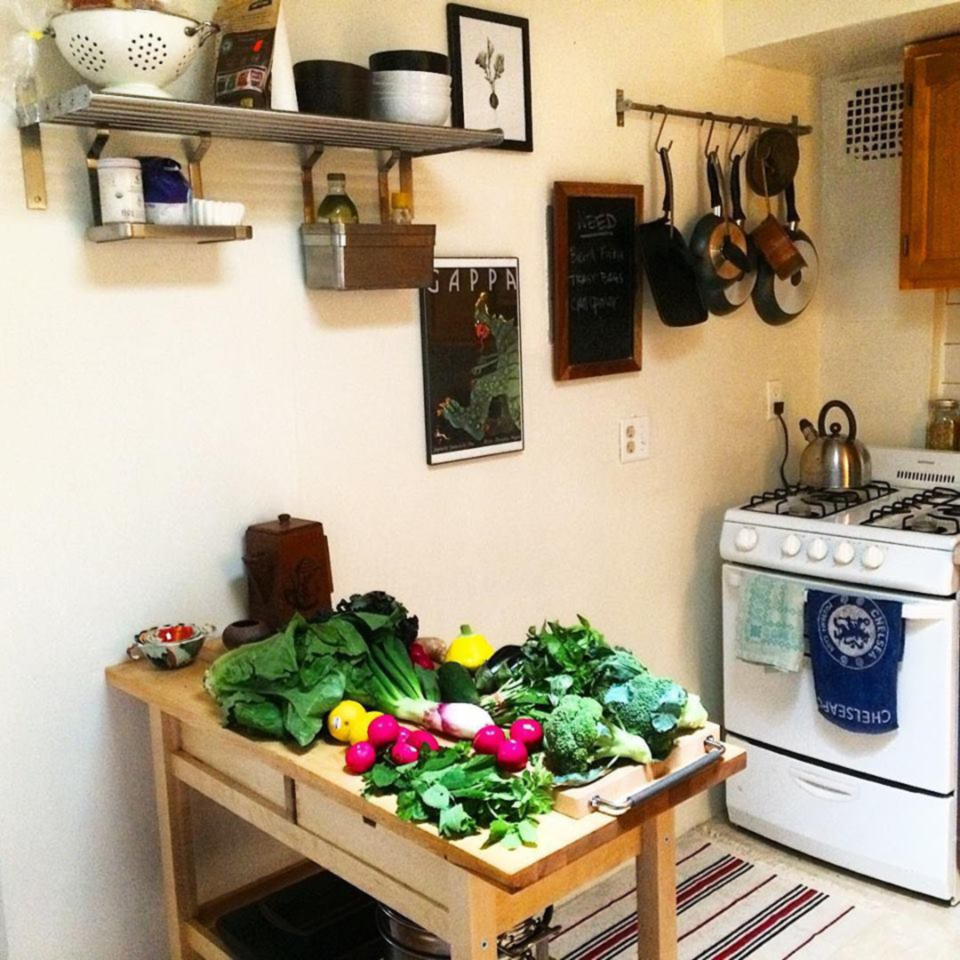
Pots and pans, kitchen utensils, on the wall: Easy way to free up cupboard space.

Pots and pans, kitchen utensils, on the wall: Easy way to free up cupboard space.

A well stocked kitchen, even on a budget, will allow you to always have the right ingredients on hand without wincing at your bank account. The right ingredients allow you to create meal plans which encourage cooking at home, which all means you don't want to crawl under your bed and cry every time you look at your bank account. It's a truly gorgeous cycle.

In order to really get a sense of what I needed I took a few action steps: 

  1. Wrote down which items I am willing to spend the most money on: high quality meat and dairy. 
  2. Surveyed which stores are most accessible to me in terms of price/value/distance- in New York where getting anywhere is a huge hassle it makes a lot of sense to survey your grocery environment.
  3. Made a plan for how to purchase items on a monthly basis that would result in the least time and money spent on the most healthy/functional items. For me this means one trip every month to the nearest Trader Joe's (large variety of organic/hormone free options for a great value) to stock up on meat, cheese, pasta, and grain followed by supplementary trips to my local markets for fresh produce.  

Finally, I made a shopping list of the bare essentials which I needed to get my kitchen going. These are not fancy, trendy, or hip ingredients. These are healthy, functional, affordable items that will help with making meal plans and delicious food day after day. Use these as a guide- I intentionally left out brands so that you don't feel pressured to only buy the high end or off brand options. Budgets are individual and no one should feel pressure to only purchase organic or local if they cannot afford to do so. 

Pantry: 

I don't have a ton of cupboard space in my kitchen and made it my goal to remind myself to eat more healthy grains, beans, and plant based foods. I set out all my dry goods in jars along my stove as an easy solution and incentive. 

Grains/Flours/Nuts:

  • All- purpose flour 
  • Rice: white, brown jasmine, basmati, etc. any of these are a good start depends on which you prefer.
  • Cornmeal: very affordable and perfect for breads, tortillas, bases, etc. 
  • Lentil
  • Farro
  • Couscous
  • Pasta: again, your preference. 
  • Buckwheat
  • Quinoa 
  • Rolled oats
  • Almonds
  • Walnuts

Basics:

  • Salt
  • Pepper
  • Apple cider vinegar
  • Red wine vinegar
  • Balsamic vinegar
  • Extra virgin olive oil
  • Coconut oil: this is trendy right now but it is very affordable and a great substitute for more expensive oils if money is tight and every glug of olive oil means pennies you're not saving. 
  • Onions
  • Garlic
  • Potatoes 
  • Lemons

Canned Goods:

  • Tomato paste
  • Canned diced tomatoes
  • Canned corn
  • Chickpeas
  • Canned beans: refried, black, cannellini, navy, etc. 
  • Chicken/beef/vegetable broth: I prefer canned to cubes but this is a very personal choice.
  • Roasted red peppers
  • Olives
  • Tuna

Baking/Sweeteners:

  • Baking powder
  • Baking soda
  • Granulated sugar
  • Brown sugar
  • Honey
  • Maple syrup
  • Vanilla extract
  • Chocolate powder, bar, chips

Herbs + Spices:

It's great if you can have some of these whole or fresh but not a must. (Not everyone has the sunlight/space to grow basil in a pot they glazed during their yearly yoga retreat. )

  • Ground cinnamon
  • Ground nutmeg
  • Ground cloves
  • Bay leaves
  • Cayenne pepper
  • Oregano
  • Basil
  • Parsley
  • Rosemary
  • Thyme 
  • Paprika
  • Ginger
  • Cumin
  • Turmeric 

Condiments: 

  • Mustard
  • Ketchup
  • Soy sauce
  • Worcestershire sauce
  • Mayonnaise 
  • Tahini: surprisingly affordable and great for dressings, bases, etc. 

Refrigerator:

Freezer:

  • Frozen berries: strawberries, raspberries, blueberries, etc.
  • Frozen meats: I buy meat in bulk at Trader Joe's or similar locations with affordable organic meats and freeze them for the entire month. 
    • ground beef, ground turkey, boneless skinless chicken breast, one whole chicken every month. 
  • Puff Pastry Dough
  • Pre-made pie crust: sometimes you just won't have the time to make your own and That. Is. Ok. 

Fridge:

  • Plain Greek yogurt
  • Milk
  • Cheese: parmesan, mozzarella, feta, etc.
  • Butter
  • Eggs


This is a list of the items I began with before I very slowly started to build up my pantry further. Beyond this list of basics every cook has a very different approach to what he/she considers staple ingredients. Also, I didn't include bread because duh. 


Spring Mushroom, Spinach, + Chickpea Soup

I know spring has arrived because I am not tempted to wake up on the weekends, reposition myself on the living room couch, and spend 3 hours watching Storage Wars wishing I had a warm locker in CA to hibernate in. Also, I switch from ice cream to sorbet as my snack of choice. That's a sure sign that spring is officially here. 

FullSizeRender (16).jpg

DC this time of year is stunning. Every tree has blossoms on it, streets are popping with flowers, the sky is extra blue- it really feels like walking through a movie set at times. Instead of holing up in the apartment I've been up early, venturing out to explore the city that will be my home for only two more months. 

Cooking healthy and on a budget in the winter months is an arduous endeavor when you live in an area where the cold prevents most vegetables and greens from growing. Springtime feels like a literal weight off the shoulders in this regard. Greens and veggies are bountiful and frequently on sale. Just last week at my local Safeway raspberries were a dollar a carton, bunches of spinach were $2, and I picked up 2lb. of white button mushrooms for only $5. 

The common button mushroom (Agaricus bisporus) is often passed over on other cooking blogs and even scoffed at for being too simple and boring. Time and again I stop myself from preparing these recipes because they call for scouring health food stores for expensive, hard to find varieties that need soaking and massaging. If I'm going to spend money soaking or massaging anything these days, 9 times out of 10, it's going to be me.  

These "ordinary" mushrooms are not only affordable and remarkably flavorful when cooked, they are also super healthy. In fact, "...health experts and nutritionists refer to Agaricus bisporus mushrooms as nature’s nutritional supplement. That’s because mushrooms are loaded with the nutrients our bodies need to generate energy and repair cells — including digestive enzymes, a spectrum of B vitamins, protein, and vitamin D2."  There is no need to purchase fancy and expensive mushrooms in order to make recipes calling for risottos, sides, pies, etc. White button mushrooms will do as they soak up tons of flavor and are incredibly hearty. 

With the weather so lovely and warm, my cravings for lunch have changed quite a bit as well. Instead of heavy sandwiches, slices of pizza, and wraps I'm craving light, easy, and nutritious foods. Over the weekend I made this filling yet light mushroom, spinach, and chickpea soup. The only groceries I needed were $5 worth of button mushrooms, 2 cans of chickpeas, and a handful of spinach. All the main ingredients were on sale and prep and cooking time took only 1 hour. I store all my soups in glass jars because they take up less space and are remarkably easy to transport without spilling. For lunch this week I've been keeping the soup in the fridge at work and packing up some cornbread (made using Mark Bittman's healthy, yogurt based recipe) as a side. In total, this lunch cost me less than $10 and has been a healthy and flavorful mid-day meal all week long. Give it a try!

Spring Mushroom, Spinach, + Chickpea Soup

Ingredients

  • 1-2 lbs. white button mushrooms, rinsed well, stems removed, rough chop
  • 1 lb spinach, roughly chopped
  • 2 stalks celery, chopped
  • 1-3 medium carrots, chopped
  • 2 cans chickpeas, drained +rinsed
  • 1 yellow onion, small dice
  • 3 cloves garlic, finely chopped
  • 5 cups chicken or vegetable stock
  • 1 tbsp. paprika
  • 1/2 tbsp. cumin
  • 1-2 tbsp. olive oil
  • 1 tbsp. balsamic vinegar
  • s+p
  1. In a heavy pot over medium heat, warm olive oil. Add chickpeas, onion, s+p, and sauteé, until light brown and fragrant. 
  2. Add mushrooms, carrots, celery, garlic, paprika, and cumin and cook stirring often until the mushrooms begin to lose their liquid and start turning golden.
  3. Add spinach and continue stirring and cooking until the greens begin to wilt and turn a darker color.
  4. Add balsamic and give everything a good stir, picking up any bits that stick to the bottom.
  5. Pour in stock and bring to a boil. Cover, turn down to simmer, and cook for 15-20min. 
  6. Adjust the seasonings to your taste. Add more s+p, paprika, cumin. Red chile flakes for spice, if you like. 
  7. Season with a hearty cheese like Parmesan or Asiago and serve with a side of warm cornbread. 


On Privilege and the Farmer's Market

I wake up every Saturday with a grandiose plan to head out to one of the three local farmer's markets in my neighborhood and stock up on fresh, seasonal produce- enough to feed myself for a week.  Purchasing all my week's groceries and meal planning around the local market is a cute and completely unrealistic fantasy I have. Why unrealistic? Because the cost of a weekend jaunt to the farmer's market in DC would leave my bank account whimpering. 

Farmer's markets in many urban environments are far from affordable and even the smallest purchases can set you back in a serious way. The high cost is no accident. The reality is the cost of fruits, vegetables, eggs, and milk from your local farmer is the actual cost of food production. The cheap food we get at the grocery store is cheap for a reason. In fact, "The U.S. agricultural industry can now produce unlimited quantities of meat and grains at remarkably cheap prices. But it does so at a high cost to the environment, animals, and humans…our food is increasingly bad for us, even dangerous... A food system — from seed to 7‑Eleven — that generates cheap, filling food at the literal expense of healthier produce is also a principal cause of America’s obesity epidemic."  

Unfortunately, shopping for groceries exclusively at the market (or organic aisle, Whole Foods, etc.) is not a reality for me- it's a choice that I factor into my budget and meal planning because I have the privilege to do so. There is a trend in food blogging right now that preaches local, organic, sustainable eating at any cost. Assumptions are made that eating this way is something that anyone can do, that it is easy, and shopping/cooking in any other fashion is unethical. In reality, there is a large number of people (myself included) that cannot make an entire recipe from exclusively organic/local ingredients. I think it is irresponsible to propagate the myth that this is an accessible lifestyle. So many bloggers feature recipes bearing the stamp of "local eggs, butcher's bacon, grass fed beef, etc." and preach this as the norm. These bloggers are leaving out a very important, critical piece of the puzzle: shopping/eating sustainably, locally, organically is a HUGE privilege.  Eating sustainably/locally/organically is a choice that I make, when I can, because I have the privilege to do so. That is why, on this site, you will never see a recipe calling for "organic" or "local" anything. Eating healthy should not depend on your budget. 

The market guarantees local, fresh, seasonal produce (a sustainable eater's wet dream) but when it comes time to pull the trigger on buying four carrots at $2 a pop, I hesitate. Not to imply that I don't partake in the weekly ritual- rather I do so knowing that I have a tight budget to keep and making sure I stick to it.

As with all my meal planning and shopping, I have tried turning to various articles and blogs for tips on navigating the local market in a pragmatic way. Over and over again, I've discovered two basic "tips" for what I should be doing:

1. getting to know/befriending my local farmer

2. offering a barter for goods prepared myself- jam for cucumbers, granola for squash, etc.

I find these tips silly. I barely have time to barter with my boyfriend for who will make the bed on most days, let alone a complete stranger in their place of business. These "tips" are also very condescending to the vendors. Expecting a farmer to take your homemade pickles instead of cash is a projected, gentrified fantasy of what a farmer is and does. Vendors aren't waking up at sunrise, loading backbreaking quantities of produce, and travelling long distances to the market to pal around with you or be featured on your Instagram feed. They aren't a prop to an imagined urban, sustainable life that can be put up on Pinterest. They are at the market to do business.  A study conducted at the University of Wisconsin-Madison found that "The market gardeners with fewer than 3 acres worked an average of 2,000 hours per acre at an average net cash hourly wage (net cash income/hours worked) of about $5."  As a close friend recently pointed out, the idea of bartering at a farmer's market for your homemade goods is similar to someone coming up to you at work and saying, "Oh, you don't make $__ an hour anymore but here's a bundt cake". The expectation that a farmer wants to participate in this aspect of trendy, urban homesteading culture is insulting to the amount of work that it takes to grow and harvest their product. 

Eating locally and organically on a budget is not easy, but to some extent not impossible. I want to start a conversation on eating healthy on a budget and share some of my tips for shopping at the market. 

Market Budget:

1. Know what you're shopping for. Going to the market without a plan is exactly like going to the grocery store on an empty stomach. I like to use my market shopping to pick up produce required for dishes that won't be as fresh, seasonal, or flavorful as the same ingredient at the grocery. For example, heirloom tomatoes from the market are worth every penny because the flavor/size can't compete with the store version. Sweet corn on the other hand is not- why spend $2 on one stalk when you can usually pick up 10/$10 at the grocery?

2. Know your season + Buy in bulk. Seasonal foods yield higher volumes which means lower prices. You can buy an entire crate of berries/tomatoes/peaches from the market and then preserve the remains for seasons to come. My tomato sauce in the winter is made from tomatoes I picked up at the summer market. Berries that I put into my pies in the fall are frozen farmer's berries from the July market. 

3. Go early for the freshest produce and best picks. Go late and buy up the remains from the daymany times the vendors will discount toward the end of the market just to move product. (End of day is a great time to buy up full crates of produce to use for jams, sauces, etc.)

4. Don't be afraid of the ugly. You are not Snow White and every apple doesn't need to be perfect from every angle. Buy the bruised and battered produce because many times it's discounted and I promise will taste exactly the same in your pie, salad, homemade artisanal pickles, etc. (Even over a decade ago studies referred to in the NYT cited that "High cosmetic quality standards, including those in U.S.D.A. grades, are a significant barrier to the reduction of pesticide use in growing fresh fruits and vegetables." ) Furthermore, market produce is harvested during peak season and is often bruised or battered because it has been transported when it is at it's most ripe. 

Eating locally and sustainably is a very important part of my everyday life and I try to factor it into my budget as much and whenever possible. I am sure that many you feel the same way and run into the similar problem of eating locally vs. budget friendly eating. What are some of your tips/solutions for this problem?